Antigravity Concepts & Reference Frameworks
Expand Glossary Terms
The Schwinger Limit defines the immense electric field strength at which the quantum vacuum becomes unstable and spontaneously produces particle–antiparticle pairs, revealing that “empty space” is an active, nonlinear medium at extreme energies. For anti-gravity research, this threshold is important not as a practical operating point, but as a conceptual boundary showing that sufficiently intense fields can restructure vacuum energy and its interaction with matter. By motivating efforts to achieve similar vacuum polarization effects through resonant, transient, or geometry-enhanced fields—rather than brute force—the Schwinger Limit supports the broader research direction that gravity-like effects might be modulated indirectly via quantum electrodynamics, keeping the pursuit grounded in known physics while encouraging innovative, lower-energy approaches.
The Pais Effect, attributed to Salvatore Cezar Pais, describes a speculative mechanism in which extremely high-energy electromagnetic fields—especially when rapidly accelerated or time-varying—could polarize the quantum vacuum and locally alter spacetime properties. In this view, engineered field configurations might reduce effective inertial or gravitational coupling by redistributing energy density in the vacuum itself, opening a theoretical pathway to propulsion without reaction mass. While still unproven, the idea is compelling for anti-gravity research because it reframes gravity and inertia as emergent, field-responsive phenomena rather than immutable forces, suggesting that advanced materials and power systems could someday access regimes where spacetime geometry becomes an engineering variable.
The Casimir effect arises from quantum vacuum fluctuations between closely spaced conductive surfaces, producing a measurable force due to altered electromagnetic boundary conditions. Its relevance to antigravity research lies in demonstrating that vacuum energy density is physically real and dependent on geometry.
Zero-point energy refers to the irreducible energy present in quantum fields even at absolute zero. It establishes that empty space contains structured energy, forming the conceptual basis for vacuum-interaction propulsion theories.
Vacuum fluctuations describe transient energy variations inherent to quantum fields. These fluctuations demonstrate that spacetime is dynamically active rather than inert, influencing many speculative propulsion and field-interaction models.
Negative energy density appears in constrained quantum systems such as Casimir configurations. While forbidden in classical physics, it is permitted under quantum inequalities and is frequently referenced in spacetime engineering discussions.
Metric engineering refers to the theoretical manipulation of spacetime geometry rather than the application of force. Instead of counteracting gravity, it reshapes the spacetime structure governing motion.
In general relativity, gravity emerges from spacetime curvature produced by mass and energy. Any advanced propulsion system must ultimately engage with this geometric framework.
The Einstein field equations relate energy and momentum to spacetime curvature. They define the allowable configurations through which gravitational effects may be influenced.
Inertial mass determines resistance to acceleration. Some theoretical models explore whether structured fields could alter inertial response, though no macroscopic validation exists.
Gravitomagnetism describes magnetic-like gravitational effects generated by moving mass. Its experimental confirmation demonstrates that gravity possesses dynamic field components.
Frame dragging occurs when a rotating mass twists surrounding spacetime. This effect confirms that motion and rotation can influence gravitational geometry.
This tensor describes how electromagnetic fields contribute energy and momentum to spacetime. In principle, strong or structured fields can influence gravitational curvature.
Lorentz force coupling governs how charged particles respond to electromagnetic fields. Plasma propulsion systems rely on this interaction to generate thrust without mechanical contact.
Magnetohydrodynamics studies the behavior of conductive fluids in electromagnetic fields. It underpins several nonconventional propulsion concepts that replace mechanical thrust.
Scalar and vector potentials describe electromagnetic systems at a fundamental level. In certain regimes, these potentials exhibit physical significance beyond derived fields.
Nonlinear electrodynamics explores regimes where fields self-interact at high intensity. These models predict behaviors absent from classical linear systems.
Resonant cavities confine standing electromagnetic waves, enabling structured energy storage. Some propulsion experiments investigate asymmetric resonance effects.
Vacuum polarization occurs when strong fields alter virtual particle distributions. This demonstrates that vacuum properties can be modified by electromagnetic conditions.
Effective mass describes how particles behave within structured environments. Some theories explore whether effective mass could be influenced through field geometry.
The geometric phase shows that global system geometry can affect physical outcomes independent of force magnitude, inspiring topology-based propulsion ideas.
Exotic matter refers to hypothetical states with unusual energy properties. Quantum constraints severely limit its existence, defining the boundary between theory and feasibility.
Introduction
This page functions as a structured guidebook to antigravity, advanced propulsion, teleportation, and free-energy–adjacent concepts that challenge conventional aerospace and energy paradigms. Rather than presenting a single theory or speculative claim, it assembles a coherent framework drawn from physics, engineering, and field theory that explores how motion, inertia, and energy might be governed by mechanisms beyond direct momentum exchange.
Over the past century, engineers, physicists, and research institutions have repeatedly returned to a core question: whether lift, propulsion, or inertial control can be achieved through field interaction, geometry, coherence, or spacetime manipulation rather than reaction-driven systems. These investigations often operate at the margins of accepted engineering practice, yet they consistently converge on energetic and nonlocal approaches that differ fundamentally from classical propulsion models.
The materials referenced throughout this page—including patents, experimental studies, theoretical frameworks, and anomalous observations—indicate that such concepts have not arisen solely from speculation or science fiction. Instead, they reflect sustained technical inquiry, formal patent activity, and classified or semi-classified research programs probing nonconventional regimes of physics. In several instances, these efforts suggest experimental results, prototype systems, or performance characteristics that merit consideration as indicators of operational or partially operational technologies.
Taken together, this collection is intended not merely as an archive, but as a conceptual map of how antigravity, teleportation-like phenomena, and free-energy concepts may fit within a broader physical framework. By emphasizing field interaction, coherence, and spacetime structure, this page treats these ideas as part of an ongoing, distributed effort to understand propulsion and energy at a fundamental level—mechanisms that may already exist in constrained, undeclared, or poorly understood forms rather than as distant theoretical possibilities.
Magnetohydrodynamic
Propulsion Apparatus
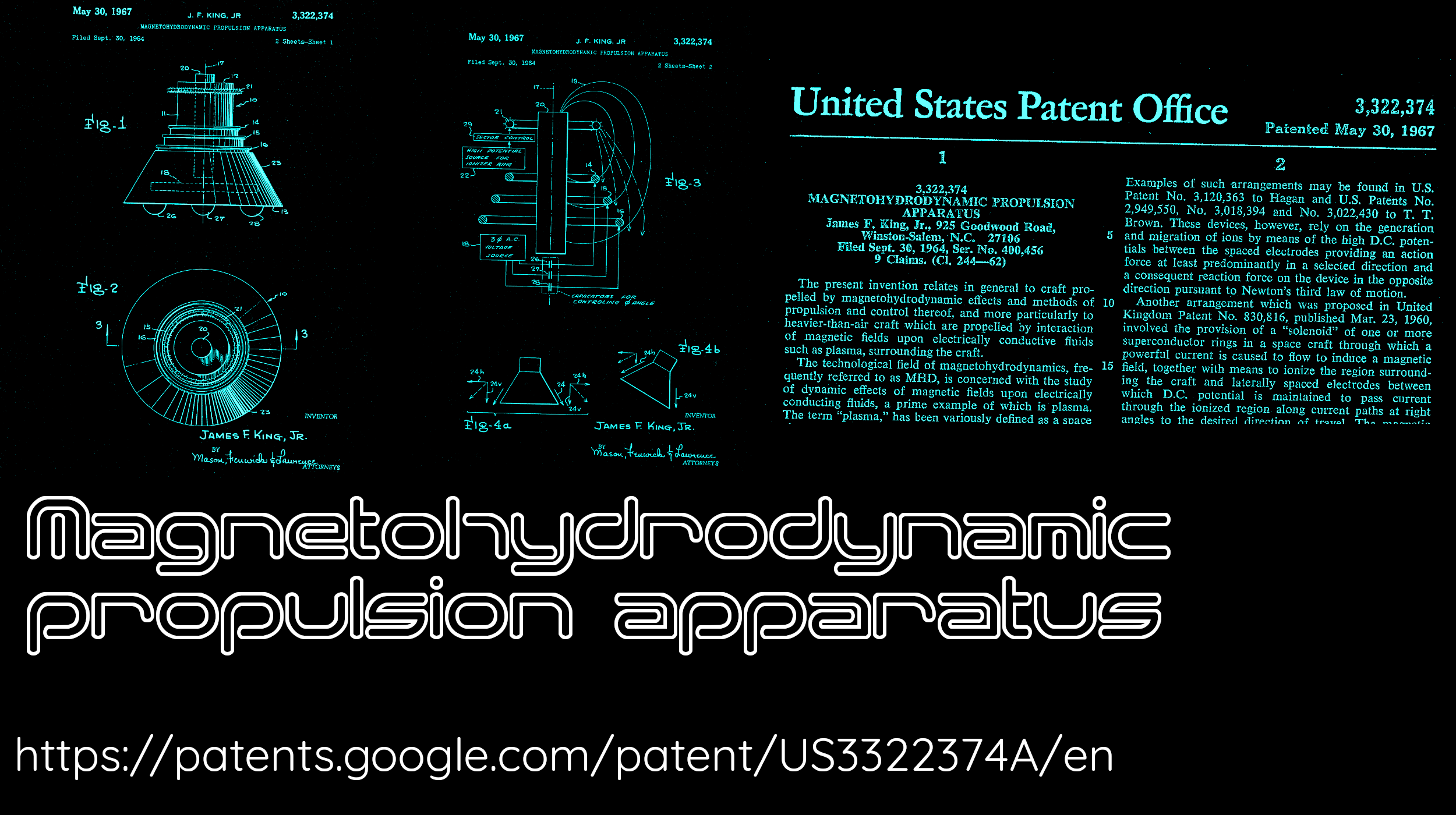
U.S. Patent No. 3,322,374
Inventor: James F. King, Jr.
Filed: September 30, 1964
Granted: May 30, 1967
United States Patent No. 3,322,374 documents a magnetohydrodynamic propulsion system designed to generate lift and thrust through electromagnetic interaction with an electrically conductive medium. The schematics illustrate a craft structured around concentric electromagnetic coils, ionization electrodes, and axially symmetric field geometries rather than mechanical propulsion elements. The formal patent presentation, multi-figure drawings, and detailed annotations indicate that this system was treated as a serious engineering proposal and evaluated accordingly by the U.S. Patent Office.
The operating principle relies on ionizing the surrounding air to form a conductive plasma, which then interacts with time-varying magnetic fields generated by stacked coils supplied with alternating or polyphase electrical currents. These fields induce circulating currents within the plasma, and the resulting Lorentz forces accelerate the ionized medium in a controlled direction. By reaction, the craft experiences thrust or lift. Importantly, thrust magnitude and direction are governed by electromagnetic field configuration and phase control rather than exhaust velocity or mechanical motion.
The patent explicitly aims to decouple propulsion from traditional aerodynamic dependence. The craft is described as operable in air, rarefied environments, or plasma regimes, suggesting a propulsion method rooted in field–medium coupling rather than pressure differentials or reaction mass expulsion. The inclusion of ionization rings, axial coil stacks, and references to superconducting elements reflects an early field-dominant propulsion architecture consistent with later antigravity-adjacent concepts, even if gravity cancellation is not explicitly claimed.
Taken together, the patent text and schematics support the conclusion that operational antigravity-adjacent technologies have been formally engineered, patented, and studied within orthodox institutional frameworks. While public evidence of full-scale deployment remains limited, the existence of this patent demonstrates that electromagnetic field propulsion was considered sufficiently viable to warrant legal protection and technical development. It situates antigravity research within a continuum of advanced propulsion efforts based on plasma physics, electromagnetic fields, and geometric force coupling rather than folklore or speculation.
Craft Using an Inertial Mass
Reduction Device - Salvatore Cezar Pais
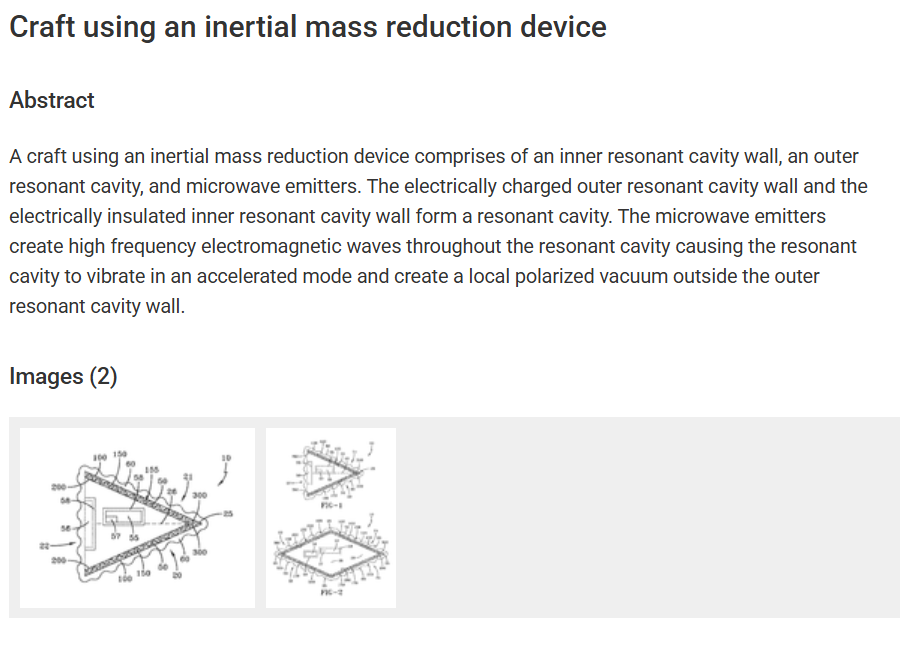
U.S. Patent No. US10144532B2
Inventor: Salvatore Cezar Pais
Filed: 2016-04-28
Granted: 2018-12-04
Abstract
A craft using an inertial mass reduction device comprises of an inner resonant cavity wall, an outer resonant cavity, and microwave emitters. The electrically charged outer resonant cavity wall and the electrically insulated inner resonant cavity wall form a resonant cavity. The microwave emitters create high frequency electromagnetic waves throughout the resonant cavity causing the resonant cavity to vibrate in an accelerated mode and create a local polarized vacuum outside the outer resonant cavity wall.
High Frequency Gravitational Wave Generator - Salvatore Cezar Pais
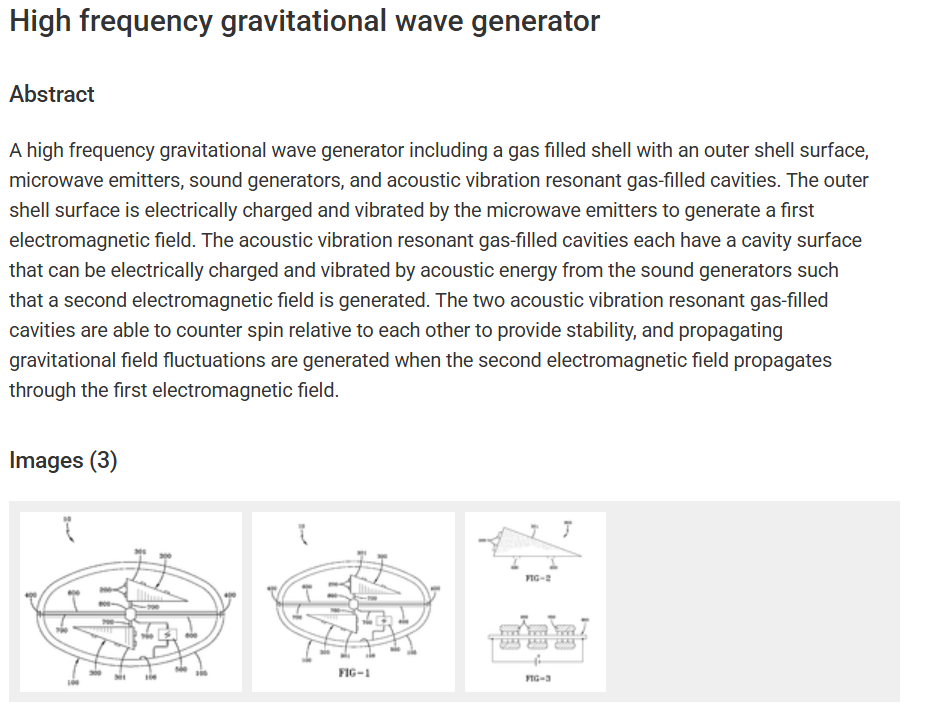
U.S. Patent No. US10322827B2
Inventor: Salvatore Cezar Pais
Filed: 2017-02-14
Granted: 2019-06-18
Abstract
A high frequency gravitational wave generator including a gas filled shell with an outer shell surface, microwave emitters, sound generators, and acoustic vibration resonant gas-filled cavities. The outer shell surface is electrically charged and vibrated by the microwave emitters to generate a first electromagnetic field. The acoustic vibration resonant gas-filled cavities each have a cavity surface that can be electrically charged and vibrated by acoustic energy from the sound generators such that a second electromagnetic field is generated. The two acoustic vibration resonant gas-filled cavities are able to counter spin relative to each other to provide stability, and propagating gravitational field fluctuations are generated when the second electromagnetic field propagates through the first electromagnetic field.
Piezoelectricity-induced High Temperature Superconductor
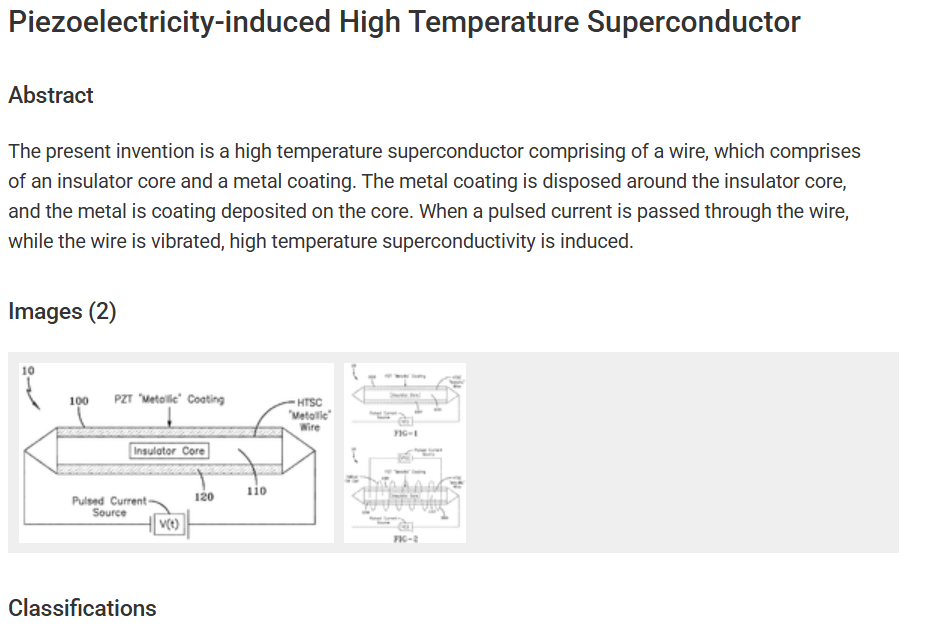
U.S. Patent No.US20190348597A1
Inventor: Salvatore Cezar Pais
Filed: 2019-07-23
Granted: Abandoned
Abstract
The present invention is a high temperature superconductor comprising of a wire, which comprises of an insulator core and a metal coating. The metal coating is disposed around the insulator core, and the metal is coating deposited on the core. When a pulsed current is passed through the wire, while the wire is vibrated, high temperature superconductivity is induced.